Key Components of a Drone: Breaking Down the Parts
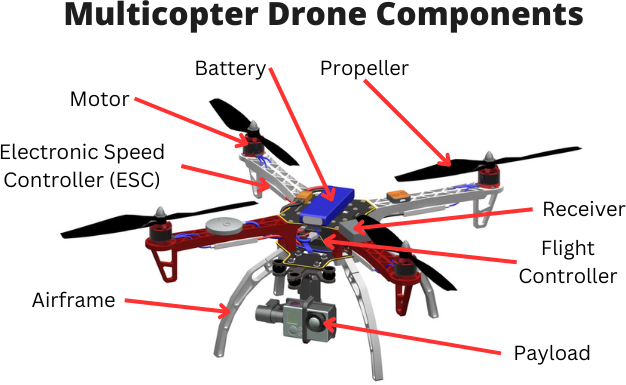
To design a drone, it's essential to be familiar with its components and understand the role each one plays in its performance and functionality. These are the main components of a drone:
-
Airframe: The drone's structural framework that holds all components together, affecting its strength, durability, and how it moves through the air. While this diagram shows a typical 'quadcopter' design with four propellers, other configurations like hexacopters (six propellers) and octocopters (eight propellers) exist for different purposes.
-
Propellers: Rotating blades that create lift by pushing air downward. This lift allows the drone to take off, hover, and move in any direction.
-
Motors: These drive the propellers, converting electrical energy into the mechanical force needed to produce thrust. Most drones use brushless motors because they are lightweight, efficient, and powerful.
-
Electronic Speed Controllers (ESCs): Devices that control the speed and direction of the motors, allowing for precise adjustments that keep the drone stable and responsive to commands.
-
Flight Controller: The drone's "brain," which processes sensor data and sends instructions to the motors to maintain stability and control during flight.
-
Receiver: A device that picks up signals from the pilot's transmitter, allowing the pilot to communicate with and control the drone.
-
Battery: The power source that provides the electrical energy needed to run the motors and onboard electronics. Drones commonly use lithium polymer (LiPo) batteries because they are lightweight and store a lot of power relative to their size.
-
Payload: Additional equipment carried by the drone, such as cameras, sensors, or items for delivery. In this diagram, the payload is a camera mounted on a gimbal, which keeps it steady during flight for clear images or videos.